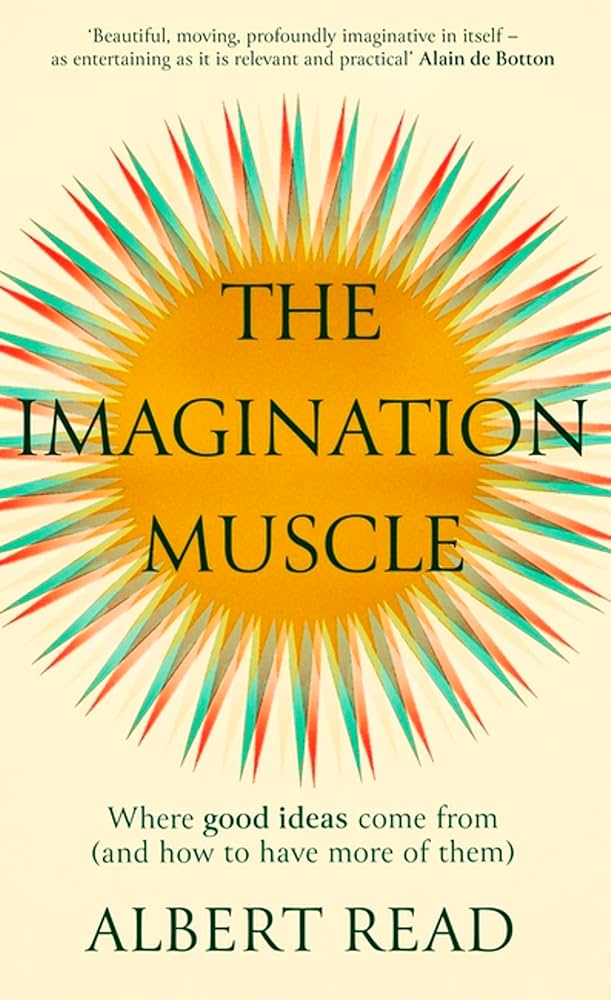
‘The Imagination Muscle‘ by Albert Read discusses where good ideas come from, and how to have more of them.
Here are my key takeaways from the book, and some related questions to consider.
These questions are included in a worksheet to help you note your responses in one place. The worksheet also includes an AI prompt to help you turn your responses into specific actions for the year ahead.
1. Use your imagination
This means imagining what doesn’t yet exist. It usually involves combining different elements or concepts in interesting new ways.
Question 1: How do you want to use your imagination to create something new this year? If nothing comes to mind, what topics are you curious about?
2. Spend time on observation and observational closure
Observation is the fuel for new ideas – but we need a way of reflecting and building on what we notice.
Question 2: What is your preferred way of noting and reflecting on what you observe?
Examples to consider:
- Drawing
- Writing
- Talking
3. Be a beginner
In ‘The Imagination Muscle’, Albert Read notes that the traditional path of imaginative achievement sees people aged 25 to 35 having the best ideas. This age group benefits from the open and flexible attitudes of youth, as well as the education and development of intelligence that comes with time. (The following graph is from page 91 of the book.)

However, the graph doesn’t have to trend downwards as we age, if we keep our minds open and continue to develop new ideas. (The following graph is from page 96 of the book.)

Question 3: Which of the following activities appeal to you, as ways to maintain your beginner’s mindset?
- Reading widely and reflecting on it (via drawing, writing or talking) to support the development of your ideas
- Seeking out constructive criticism on your draft ideas and reflecting deeply on it
- Talking with young people and taking their ideas seriously
- Travelling and learning about different cultures’ approaches to your topic
- Asking yourself harder questions when reviewing your draft ideas
- Noticing what other people are doing in your field
- Learning a new musical instrument
4. Take imaginative risks

‘The Imagination Muscle’ notes that Thomas Edison wasn’t afraid of failure – he understood that to create something genuinely new involved trial and error. And yet uncertainty and fear of failure can be paralysing, leaving us stuck with the status quo.
Question 4: What would you try doing differently, if you weren’t afraid of failing or wasting time?
5. Work across disciplines

We can be inspired by Leonardo Da Vinci (artist, scientist, engineer and more) to make leaps across disciplines.
Question 5: What cross-disciplinary skills would enhance your ideas?
Examples to consider:
- If you are a planner, could you sign up for an introductory engineering course (and vice versa)?
- Could you combine your existing expertise with the processing power of AI in some way?
- Could you bring your reports to life by creating infographics that express complex written concepts?
6. Work with existing ideas
We don’t have to start from scratch. We can create something new by combining existing ideas and knowledge in a new way.
“To place an excessive burden on originality is to crush many an idea at its birth. All of us start by working with other people’s ideas.” (From page 185 of ‘The Imagination Muscle’.)
Question 6: What existing ideas, information or frameworks could you draw on to create something new?
7. Talk to people who share your interest in a topic
Talking with people about a shared interest can help you to stretch your thinking.
Question 7: Can you think of anyone who is excited about the same topic as you are, who you could invite for coffee or an online meeting to share ideas to benefit both of you?