These six AI tools will help you:
This tool helps you see how your natural thinking style influences your community engagement approach. The tool:
This tool helps you create engagement strategies that genuinely encourage participation by people with all four thinking styles by:
This tool helps you move beyond surface-level feedback by developing powerful questions based on the ‘Coaching Habit’ methodology. Using these questions will also help your stakeholders develop new insights about the issues you discuss with them.
You can use this interactive tool to:
This tool bridges your self-awareness with practical planning. It compiles your insights from using Tools 1, 2 and 3 into a concise Engagement Summary to inform your community engagement plan.
This tool:
This tool guides you step-by-step through the process of developing a comprehensive community engagement plan that reflects both your strategic insights and your project requirements by:
If you have already prepared a consultation document, this tool extracts the key engagement insights and helps you to transform them into a comprehensive community engagement plan – ensuring you don’t overlook valuable content you have already developed. You can use this tool to:
I worked in policy and planning roles at Nelson City Council for nearly 20 years. For the past 11 years I have been providing writing and editing services for councils around New Zealand. Since 2024 I have been upskilling in AI and figuring out how to apply it to the specific work we do in the local government sector.
What are these tools based on?
Key sources include the IAP2 spectrum as discussed by The Policy Project, ‘The Coaching Habit’ by Michael Bungay Stanier, and the Herrmann Whole Brain Thinking framework.
How does the Herrmann Whole Brain Thinking framework compare to Meyers Briggs personality types?
Here’s what Learning and Development Specialist Julie Varney replied when I asked her this question in an interview published on my website:
“The advantage of Meyers Briggs is it provides a deeper, more complex understanding of yourself. It reflects more preferences (Introvert vs Extrovert, Intuition vs Sensing, Feeling vs Thinking, Perceiving vs Judging). It better addresses the complexity of our different personality types, but the downside is that it’s harder to apply than Herrmann Whole Brain Thinking, which is just four categories.
“The simpler Herrmann Whole Brain Thinking model is easier to quickly understand within a team, and to achieve an understanding of the two principles of insight about yourself, and that people are different. It is also easier to apply in a workplace.”
What if my manager questions my use of AI tools?
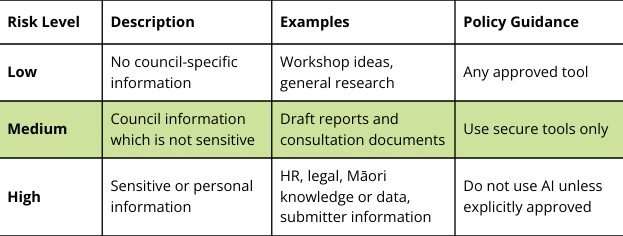
The tools use secure, GDPR-compliant platforms suitable for council information that isn’t sensitive or personal, so they are suitable for ‘medium risk’ use, as shown in the framework I have developed to guide AI use by councils.
Any sensitive or personal information should be added to your documents in Word, after you have finished using the tools to draft your content.
You can download my AI Policy Guide if you would like more details about this.
Get in touch to arrange access to the tools or to develop a customised version for use in Microsoft Copilot.
Email:
debra.bradley@writingforcouncils.co.nz
Phone: 021 215 4698